By: Jeffrey
Lee
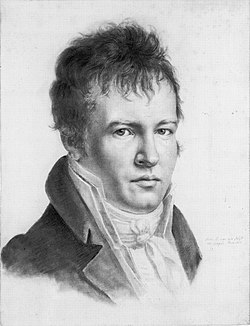 |
| Self-portrait |
Baron
Alexander von Humboldt (1769-1859) was one of the last true generalists in
science. While generally considered a geographer, he contributed to most
of the sciences of the natural environment found today. Born in Berlin,
von Humboldt’s father was Chamberlain to the King, a royal advisor, who died
when Alexander was nine years old. As a child, he received a private education
and was a slow learner and sickly much of the time. On his own, though,
he loved collecting local plants and animals and reading books on foreign
travel and adventure. He also loved to draw, mostly landscapes.
Typical of the time, science was not part of his schooling; Humboldt was
generally self taught in that area. At sixteen, he attended some lectures
on physics and philosophy by a local doctor and then he decided to pursue a
career in science.
Humboldt attended several universities, but never for very long. His mother wanted him to get a job with the Prussian Civil Service and to appease her he ended up at the Hamburg School of Commerce. There he studied intensely for his courses and with equal intensity his other interests in geology, botany and languages. He developed a liberal approach to politics and a visit to Paris in 1790, while the ideals of the French Revolution were still apparent, confirmed his convictions.
In 1791 he got a position with the Prussian Academy of Industry and Mines, where he was given a thorough education in geology at the Freiberg Mining Academy. A. G. Werner, one of the leading geologists of the day, was one of his instructors. His job with the Bureau of Mines gave him ample opportunity to travel and do scientific investigations. Some of his studies were mining related but his wide interests led him to do research on many topics in his spare time. (Throughout his life, he typically slept only three or four hours per night.) He published an exhaustive study on electrical effects on nerves and muscles, though his conclusions were quickly shown to be incorrect by the Italian physicist Alessandro Volta, namesake of the unit ‘volt’. His botanical work, however, brought him lasting acclaim in the scientific world. He became good friends with Goethe, the leading intellectual of Germany. While best known for his poetry and plays, Goethe was also a statesman and scientist. The two learned much from each other.
Humboldt’s mother died in 1796 and he was left a respectable fortune. He resigned his mining job and set out to go exploring. He was to join a British expedition to the Nile, but Napoleon invaded Egypt. Then he was set to join a French voyage around the world, but war with Austria broke out and the government withdrew the funds. While preparing for this voyage, though, he met Aimé Bonpland, a French botanist. The two became good friends and decided to set out on their own expedition at Humboldt’s expense. They convinced the King and Queen of Spain to allow them to visit the Spanish American Colonies, where few foreigners were welcome. The two sailed to the New World with a collection of the best scientific instruments Humboldt could buy. As he said in a letter, “I shall try to find out how the forces of nature interact upon one another and how the geographic environment influences plant and animal life. In other words, I must find out about the unity of nature.”
Humboldt and Bonpland spent five years in the New World. In 1799 they arrived in Venezuela. They explored the Orinoco and Rio Negro Rivers in that colony, mapping and collecting natural history specimens in the rainforest. Next they traveled in the Andes Mountains in Columbia, Ecuador and Peru. They spent several months in the city of Quito, mostly exploring the local volcanoes. Humboldt and Bonpland climbed Chimborazo, then thought to be the highest mountain in the world at 6300 meters. Humboldt and Bonpland only reached 5900 meters, but that was far higher than any known human had ever been. This feat brought international attention to Humboldt as an adventurer. (Bonpland never received the accolades that Humboldt did, presumably because Humboldt was the leader of the expedition.) Humboldt’s observations in the volcanic region led him to argue forcefully that volcanic activity is a major force in mountain building, a concept not commonly understood at the time. He also made the observation that altitude and latitude play similar roles in controlling plant types: at the base of the Andes is tropical rainforest, while at the top is tundra-type vegetation. They then spent a year in Mexico, traveling and studying the geography, economics and politics of that colony. While sailing from Peru to Mexico, Humboldt took careful measurements of the ocean current there, now known as the Humboldt Current.
Humboldt attended several universities, but never for very long. His mother wanted him to get a job with the Prussian Civil Service and to appease her he ended up at the Hamburg School of Commerce. There he studied intensely for his courses and with equal intensity his other interests in geology, botany and languages. He developed a liberal approach to politics and a visit to Paris in 1790, while the ideals of the French Revolution were still apparent, confirmed his convictions.
In 1791 he got a position with the Prussian Academy of Industry and Mines, where he was given a thorough education in geology at the Freiberg Mining Academy. A. G. Werner, one of the leading geologists of the day, was one of his instructors. His job with the Bureau of Mines gave him ample opportunity to travel and do scientific investigations. Some of his studies were mining related but his wide interests led him to do research on many topics in his spare time. (Throughout his life, he typically slept only three or four hours per night.) He published an exhaustive study on electrical effects on nerves and muscles, though his conclusions were quickly shown to be incorrect by the Italian physicist Alessandro Volta, namesake of the unit ‘volt’. His botanical work, however, brought him lasting acclaim in the scientific world. He became good friends with Goethe, the leading intellectual of Germany. While best known for his poetry and plays, Goethe was also a statesman and scientist. The two learned much from each other.
Humboldt’s mother died in 1796 and he was left a respectable fortune. He resigned his mining job and set out to go exploring. He was to join a British expedition to the Nile, but Napoleon invaded Egypt. Then he was set to join a French voyage around the world, but war with Austria broke out and the government withdrew the funds. While preparing for this voyage, though, he met Aimé Bonpland, a French botanist. The two became good friends and decided to set out on their own expedition at Humboldt’s expense. They convinced the King and Queen of Spain to allow them to visit the Spanish American Colonies, where few foreigners were welcome. The two sailed to the New World with a collection of the best scientific instruments Humboldt could buy. As he said in a letter, “I shall try to find out how the forces of nature interact upon one another and how the geographic environment influences plant and animal life. In other words, I must find out about the unity of nature.”
Humboldt and Bonpland spent five years in the New World. In 1799 they arrived in Venezuela. They explored the Orinoco and Rio Negro Rivers in that colony, mapping and collecting natural history specimens in the rainforest. Next they traveled in the Andes Mountains in Columbia, Ecuador and Peru. They spent several months in the city of Quito, mostly exploring the local volcanoes. Humboldt and Bonpland climbed Chimborazo, then thought to be the highest mountain in the world at 6300 meters. Humboldt and Bonpland only reached 5900 meters, but that was far higher than any known human had ever been. This feat brought international attention to Humboldt as an adventurer. (Bonpland never received the accolades that Humboldt did, presumably because Humboldt was the leader of the expedition.) Humboldt’s observations in the volcanic region led him to argue forcefully that volcanic activity is a major force in mountain building, a concept not commonly understood at the time. He also made the observation that altitude and latitude play similar roles in controlling plant types: at the base of the Andes is tropical rainforest, while at the top is tundra-type vegetation. They then spent a year in Mexico, traveling and studying the geography, economics and politics of that colony. While sailing from Peru to Mexico, Humboldt took careful measurements of the ocean current there, now known as the Humboldt Current.
Before returning to Europe in 1804, they visited the young United States. In Philadelphia they were treated warmly by the American Philosophical Society, the leading scientific organization in the country. They also stayed with President Thomas Jefferson in Washington D.C., a small town still under construction. Humboldt and Jefferson shared a love of science and had similar political philosophies. Dolly Madison, wife of then Secretary of State James Madison, said of Humboldt: “We have lately had a great treat in the company of a charming Prussian Baron von Humboldt. All the ladies say they are in love with him…. He is the most polite, modest, well-informed and interesting traveler we have ever met, and is much pleased with America.”
In their five year journey, Humboldt and Bonpland traveled 10000 kilometers through difficult terrain. They returned with over 60000 plant specimens, along with geological, ethnographic and zoological collections. In addition, they had a wealth of astronomical, oceanographic, meteorological and magnetic observations and they corrected the latitude and longitude positions of many geographic features.
Humboldt returned as a grand celebrity in Europe, especially Paris where he lived. He worked on publications and socialized much, and he wrote between one and two thousand letters each year. Napoleon never trusted the Prussian Humboldt and the secret police watched him and broke into his home often to copy his papers (with quill pen and ink!). In spite of this, Paris was the intellectual center Humboldt required and he lived there for twenty-five years after his return from the Americas. Humboldt never married and it is generally assumed that he was homosexual. This is based on some love letters he wrote as a young man and the many close relationships he had with men throughout his life.
The publications resulting from the American expedition took thirty years to complete. The thirty volumes of [[Voyage de Humboldt et Bonpland ]]are a mix of scientific results, geographic and economic studies, and travel/adventure books. He often worked with experts in various fields on the scientific volumes. Humboldt wrote on climatology, geology, ecology, biogeography, economic geography, oceanography, ethnography, and history. Bringing the books to fruition broke Humboldt financially; he had to pay for the artists who illustrated them along with the engravings and general printing costs. Sales of the necessarily pricey books never made up for the expenses.
Bonpland participated in some of the botanical work, but while he was a superb field scientist, he was generally incompetent at desk work. He became superintendent of gardens for Empress Josephine, had a short marriage, and in 1816 he returned to South America. He worked as a professor in Argentina and while on an expedition to an area disputed by Argentina and Paraguay, the Paraguayans took him prisoner. They held him for nine years, despite Humboldt’s diplomatic efforts to get his friend released. Later, Bonpland settled in Uruguay and seems to have led a happy life living in a mud hut, doing botanical work, and raising children until he died at age 85. After Humboldt and Bonpland returned to France in 1804, the French government awarded Bonpland a 3000 franc pension as thanks for his achievements; each year Humboldt made sure that it was sent to his friend in South America.
In 1827 Humboldt left Paris for Berlin, serving as Chamberlain to the King of Prussia, Frederick William III. One of his duties was to report on cultural and scientific matters. Though he got along well with the King, the liberal Humboldt was never truly welcomed at the mostly reactionary Royal Court. In Berlin, he gave a six month series of university lectures on physical geography. These proved so popular that he gave another series to the public at a local concert hall. His main purpose was to show that science was a better way to learn about nature. The Romantic Movement in Germany led to ‘natural philosophers’ who felt that intuition was the best route to understanding, not cold empiricism. Humboldt showed that science was the more effective approach to knowledge on empirical matters.
Humboldt tried for years to make another scientific expedition, preferably to Asia. In 1829 he was granted permission to travel in Russia for six months. Tsar Nicholas I paid for the trip, hoping that Humboldt’s assessment of mining in the Ural Mountains would prove valuable. Zoologist C. G. E. Ehrenberg and Gustav Rose, a chemist and minerologist, joined the sixty year old Humboldt on the trip. They spent a month in the Urals, then moved on to Siberia. After reaching the Chinese border, they returned to Moscow via the Caspian Sea. In the six months they traveled over 15000 kilometers within Russia, some by river but most by carriage. The scholarly work produced by the Siberian Expedition was far less extensive than Humboldt’s American work and he left the writing to Ehrenberg and Rose. They produced a three volume geography of Central Asia.
Humboldt and his friend, mathematician Karl Gauss, set out to organize a global network of magnetic and meteorological monitoring stations. He used his new contacts in Russia to set up stations across that country and Gauss convinced European governments to do the same. Humboldt convinced the British to set up stations throughout their Empire and the United States already had a similar network in operation. This was the first large scale international scientific collaboration and it resulted in many advances in knowledge of magnetic and meteorological phenomena.
Humboldt’s lectures on physical geography in 1828 inspired him to write a monumental work on nature. Cosmos, Sketch of a Physical Description of the Universe took twenty five years to write. (Using Humboldt’s notes, the fifth and final volume was finished after he died.) He used all of the sciences to explain everything from the Milky Way Galaxy to microscopic organisms. Much of it he could illustrate with his own studies. More than an encyclopedia, Cosmos showed nature as a whole, not a series of unconnected parts. It also showed science to be intellectually exciting. The work was well received throughout Europe and the USA.
In 1859, a few months shy of his ninetieth birthday, Humboldt died. He was given an elaborate state funeral.
Alexander von Humboldt is sometimes criticized for being too general, not focusing on one discipline. But few scientists can match his contributions to knowledge in any one of the dozens of phenomena he studied. Among his pioneering contributions are:
- Anthropology: Insightful observations on Native American ethnography and Inca history. He was the first to suggest an Asiatic origin of Native Americans.
- Astronomy: He helped show the periodicity of meteor showers.
- Botany: Bonpland and Humboldt identified 3500 new species of American plants.
- Climatology: He was the first to extensively map temperatures across continents.
- History: He made a detailed history of the early exploration of the Americas and discovered how ‘America’ became the name of the two continents.
- Human Geography: He showed the connections between the natural environment and the course of nations.
- Geology: Humboldt showed that volcanic activity is an important factor in mountain building and he suggested that volcanoes can be associated with subterranean fault systems.
- Geophysics: Alone and with mathematician Karl Gauss, he studied variations in Earth’s magnetism across the globe.
- Meteorology: With chemist Joseph Louis Gay-Lussac, he measured the chemical composition of the atmosphere.
- Oceanography: Humboldt studied the physical properties of ocean waters.
- Physiology: He studied electrical effects on nerves and muscles and the effects of altitude on humans.
- Plant Geography and Ecology: He pioneered the concepts of environmental influences on plants.
Perhaps more important than his individual contributions, Humboldt showed, especially in Cosmos, the unity of nature. Few before or since could view the natural world on such a grand scale.
(Note: this biography was originally published in Focus on Geography, v. 46, no. 3 (2001), p. 29-30 and is reprinted here with permission of the American Geographical Society.)
Von Humboldt, Alexander

This article has been reviewed by the following Topic Editor: Peter Saundry
![Self portrait of Alexander von Humboldt, 1814. (Source: <a href='http://en.wikipedia.org/article/File:AvHumboldt.jpg' class='external free' title='http://en.wikipedia.org/article/File:AvHumboldt.jpg' rel='nofollow'>http://en.wikipedia.org/article/File:AvHumboldt.jpg</a>])](https://lh3.googleusercontent.com/blogger_img_proxy/AEn0k_sFIrBn3urhbBZJw7RDN1ao6k6E1yIB9mKRnJng7aqsAziyBoY3Xneizfk2eV8tN6TtvtWfezCDkI7fLOO8dze-vvnbN3ps9gXN_Uic4p1R7z_xSRXJ_VTOS1Jr9L-DdajZ62Gg3fPt1g=s0-d) Self portrait of Alexander von Humboldt, 1814. (Source: http://en.wikipedia.org/article/File:AvHumboldt.jpg])
Self portrait of Alexander von Humboldt, 1814. (Source: http://en.wikipedia.org/article/File:AvHumboldt.jpg])
Humboldt attended several universities, but never for very long. His mother wanted him to get a job with the Prussian Civil Service and to appease her he ended up at the Hamburg School of Commerce. There he studied intensely for his courses and with equal intensity his other interests in geology, botany and languages. He developed a liberal approach to politics and a visit to Paris in 1790, while the ideals of the French Revolution were still apparent, confirmed his convictions.
In 1791 he got a position with the Prussian Academy of Industry and Mines, where he was given a thorough education in geology at the Freiberg Mining Academy. A. G. Werner, one of the leading geologists of the day, was one of his instructors. His job with the Bureau of Mines gave him ample opportunity to travel and do scientific investigations. Some of his studies were mining related but his wide interests led him to do research on many topics in his spare time. (Throughout his life, he typically slept only three or four hours per night.) He published an exhaustive study on electrical effects on nerves and muscles, though his conclusions were quickly shown to be incorrect by the Italian physicist Alessandro Volta, namesake of the unit ‘volt’. His botanical work, however, brought him lasting acclaim in the scientific world. He became good friends with Goethe, the leading intellectual of Germany. While best known for his poetry and plays, Goethe was also a statesman and scientist. The two learned much from each other.
Humboldt’s mother died in 1796 and he was left a respectable fortune. He resigned his mining job and set out to go exploring. He was to join a British expedition to the Nile, but Napoleon invaded Egypt. Then he was set to join a French voyage around the world, but war with Austria broke out and the government withdrew the funds. While preparing for this voyage, though, he met Aimé Bonpland, a French botanist. The two became good friends and decided to set out on their own expedition at Humboldt’s expense. They convinced the King and Queen of Spain to allow them to visit the Spanish American Colonies, where few foreigners were welcome. The two sailed to the New World with a collection of the best scientific instruments Humboldt could buy. As he said in a letter, “I shall try to find out how the forces of nature interact upon one another and how the geographic environment influences plant and animal life. In other words, I must find out about the unity of nature.”
Humboldt and Bonpland spent five years in the New World. In 1799 they arrived in Venezuela. They explored the Orinoco and Rio Negro Rivers in that colony, mapping and collecting natural history specimens in the rainforest. Next they traveled in the Andes Mountains in Columbia, Ecuador and Peru. They spent several months in the city of Quito, mostly exploring the local volcanoes. Humboldt and Bonpland climbed Chimborazo, then thought to be the highest mountain in the world at 6300 meters. Humboldt and Bonpland only reached 5900 meters, but that was far higher than any known human had ever been. This feat brought international attention to Humboldt as an adventurer. (Bonpland never received the accolades that Humboldt did, presumably because Humboldt was the leader of the expedition.) Humboldt’s observations in the volcanic region led him to argue forcefully that volcanic activity is a major force in mountain building, a concept not commonly understood at the time. He also made the observation that altitude and latitude play similar roles in controlling plant types: at the base of the Andes is tropical rainforest, while at the top is tundra-type vegetation. They then spent a year in Mexico, traveling and studying the geography, economics and politics of that colony. While sailing from Peru to Mexico, Humboldt took careful measurements of the ocean current there, now known as the Humboldt Current.
Before returning to Europe in 1804, they visited the young United States. In Philadelphia they were treated warmly by the American Philosophical Society, the leading scientific organization in the country. They also stayed with President Thomas Jefferson in Washington D.C., a small town still under construction. Humboldt and Jefferson shared a love of science and had similar political philosophies. Dolly Madison, wife of then Secretary of State James Madison, said of Humboldt: “We have lately had a great treat in the company of a charming Prussian Baron von Humboldt. All the ladies say they are in love with him…. He is the most polite, modest, well-informed and interesting traveler we have ever met, and is much pleased with America.”
In their five year journey, Humboldt and Bonpland traveled 10000 kilometers through difficult terrain. They returned with over 60000 plant specimens, along with geological, ethnographic and zoological collections. In addition, they had a wealth of astronomical, oceanographic, meteorological and magnetic observations and they corrected the latitude and longitude positions of many geographic features.
Humboldt returned as a grand celebrity in Europe, especially Paris where he lived. He worked on publications and socialized much, and he wrote between one and two thousand letters each year. Napoleon never trusted the Prussian Humboldt and the secret police watched him and broke into his home often to copy his papers (with quill pen and ink!). In spite of this, Paris was the intellectual center Humboldt required and he lived there for twenty-five years after his return from the Americas. Humboldt never married and it is generally assumed that he was homosexual. This is based on some love letters he wrote as a young man and the many close relationships he had with men throughout his life.
The publications resulting from the American expedition took thirty years to complete. The thirty volumes of [[Voyage de Humboldt et Bonpland ]]are a mix of scientific results, geographic and economic studies, and travel/adventure books. He often worked with experts in various fields on the scientific volumes. Humboldt wrote on climatology, geology, ecology, biogeography, economic geography, oceanography, ethnography, and history. Bringing the books to fruition broke Humboldt financially; he had to pay for the artists who illustrated them along with the engravings and general printing costs. Sales of the necessarily pricey books never made up for the expenses.
Bonpland participated in some of the botanical work, but while he was a superb field scientist, he was generally incompetent at desk work. He became superintendent of gardens for Empress Josephine, had a short marriage, and in 1816 he returned to South America. He worked as a professor in Argentina and while on an expedition to an area disputed by Argentina and Paraguay, the Paraguayans took him prisoner. They held him for nine years, despite Humboldt’s diplomatic efforts to get his friend released. Later, Bonpland settled in Uruguay and seems to have led a happy life living in a mud hut, doing botanical work, and raising children until he died at age 85. After Humboldt and Bonpland returned to France in 1804, the French government awarded Bonpland a 3000 franc pension as thanks for his achievements; each year Humboldt made sure that it was sent to his friend in South America.
In 1827 Humboldt left Paris for Berlin, serving as Chamberlain to the King of Prussia, Frederick William III. One of his duties was to report on cultural and scientific matters. Though he got along well with the King, the liberal Humboldt was never truly welcomed at the mostly reactionary Royal Court. In Berlin, he gave a six month series of university lectures on physical geography. These proved so popular that he gave another series to the public at a local concert hall. His main purpose was to show that science was a better way to learn about nature. The Romantic Movement in Germany led to ‘natural philosophers’ who felt that intuition was the best route to understanding, not cold empiricism. Humboldt showed that science was the more effective approach to knowledge on empirical matters.
Humboldt tried for years to make another scientific expedition, preferably to Asia. In 1829 he was granted permission to travel in Russia for six months. Tsar Nicholas I paid for the trip, hoping that Humboldt’s assessment of mining in the Ural Mountains would prove valuable. Zoologist C. G. E. Ehrenberg and Gustav Rose, a chemist and minerologist, joined the sixty year old Humboldt on the trip. They spent a month in the Urals, then moved on to Siberia. After reaching the Chinese border, they returned to Moscow via the Caspian Sea. In the six months they traveled over 15000 kilometers within Russia, some by river but most by carriage. The scholarly work produced by the Siberian Expedition was far less extensive than Humboldt’s American work and he left the writing to Ehrenberg and Rose. They produced a three volume geography of Central Asia.
Humboldt and his friend, mathematician Karl Gauss, set out to organize a global network of magnetic and meteorological monitoring stations. He used his new contacts in Russia to set up stations across that country and Gauss convinced European governments to do the same. Humboldt convinced the British to set up stations throughout their Empire and the United States already had a similar network in operation. This was the first large scale international scientific collaboration and it resulted in many advances in knowledge of magnetic and meteorological phenomena.
Humboldt’s lectures on physical geography in 1828 inspired him to write a monumental work on nature. Cosmos, Sketch of a Physical Description of the Universe took twenty five years to write. (Using Humboldt’s notes, the fifth and final volume was finished after he died.) He used all of the sciences to explain everything from the Milky Way Galaxy to microscopic organisms. Much of it he could illustrate with his own studies. More than an encyclopedia, Cosmos showed nature as a whole, not a series of unconnected parts. It also showed science to be intellectually exciting. The work was well received throughout Europe and the USA.
In 1859, a few months shy of his ninetieth birthday, Humboldt died. He was given an elaborate state funeral.
Alexander von Humboldt is sometimes criticized for being too general, not focusing on one discipline. But few scientists can match his contributions to knowledge in any one of the dozens of phenomena he studied. Among his pioneering contributions are:
- Anthropology: Insightful observations on Native American ethnography and Inca history. He was the first to suggest an Asiatic origin of Native Americans.
- Astronomy: He helped show the periodicity of meteor showers.
- Botany: Bonpland and Humboldt identified 3500 new species of American plants.
- Climatology: He was the first to extensively map temperatures across continents.
- History: He made a detailed history of the early exploration of the Americas and discovered how ‘America’ became the name of the two continents.
- Human Geography: He showed the connections between the natural environment and the course of nations.
- Geology: Humboldt showed that volcanic activity is an important factor in mountain building and he suggested that volcanoes can be associated with subterranean fault systems.
- Geophysics: Alone and with mathematician Karl Gauss, he studied variations in Earth’s magnetism across the globe.
- Meteorology: With chemist Joseph Louis Gay-Lussac, he measured the chemical composition of the atmosphere.
- Oceanography: Humboldt studied the physical properties of ocean waters.
- Physiology: He studied electrical effects on nerves and muscles and the effects of altitude on humans.
- Plant Geography and Ecology: He pioneered the concepts of environmental influences on plants.
Perhaps more important than his individual contributions, Humboldt showed, especially in Cosmos, the unity of nature. Few before or since could view the natural world on such a grand scale.
(Note: this biography was originally published in Focus on Geography, v. 46, no. 3 (2001), p. 29-30 and is reprinted here with permission of the American Geographical Society.)
Von Humboldt, Alexander
This article has been reviewed by the following Topic Editor: Peter Saundry
Self portrait of Alexander von Humboldt, 1814. (Source: http://en.wikipedia.org/article/File:AvHumboldt.jpg])
Humboldt attended several universities, but never for very long. His mother wanted him to get a job with the Prussian Civil Service and to appease her he ended up at the Hamburg School of Commerce. There he studied intensely for his courses and with equal intensity his other interests in geology, botany and languages. He developed a liberal approach to politics and a visit to Paris in 1790, while the ideals of the French Revolution were still apparent, confirmed his convictions.
In 1791 he got a position with the Prussian Academy of Industry and Mines, where he was given a thorough education in geology at the Freiberg Mining Academy. A. G. Werner, one of the leading geologists of the day, was one of his instructors. His job with the Bureau of Mines gave him ample opportunity to travel and do scientific investigations. Some of his studies were mining related but his wide interests led him to do research on many topics in his spare time. (Throughout his life, he typically slept only three or four hours per night.) He published an exhaustive study on electrical effects on nerves and muscles, though his conclusions were quickly shown to be incorrect by the Italian physicist Alessandro Volta, namesake of the unit ‘volt’. His botanical work, however, brought him lasting acclaim in the scientific world. He became good friends with Goethe, the leading intellectual of Germany. While best known for his poetry and plays, Goethe was also a statesman and scientist. The two learned much from each other.
Humboldt’s mother died in 1796 and he was left a respectable fortune. He resigned his mining job and set out to go exploring. He was to join a British expedition to the Nile, but Napoleon invaded Egypt. Then he was set to join a French voyage around the world, but war with Austria broke out and the government withdrew the funds. While preparing for this voyage, though, he met Aimé Bonpland, a French botanist. The two became good friends and decided to set out on their own expedition at Humboldt’s expense. They convinced the King and Queen of Spain to allow them to visit the Spanish American Colonies, where few foreigners were welcome. The two sailed to the New World with a collection of the best scientific instruments Humboldt could buy. As he said in a letter, “I shall try to find out how the forces of nature interact upon one another and how the geographic environment influences plant and animal life. In other words, I must find out about the unity of nature.”
Humboldt and Bonpland spent five years in the New World. In 1799 they arrived in Venezuela. They explored the Orinoco and Rio Negro Rivers in that colony, mapping and collecting natural history specimens in the rainforest. Next they traveled in the Andes Mountains in Columbia, Ecuador and Peru. They spent several months in the city of Quito, mostly exploring the local volcanoes. Humboldt and Bonpland climbed Chimborazo, then thought to be the highest mountain in the world at 6300 meters. Humboldt and Bonpland only reached 5900 meters, but that was far higher than any known human had ever been. This feat brought international attention to Humboldt as an adventurer. (Bonpland never received the accolades that Humboldt did, presumably because Humboldt was the leader of the expedition.) Humboldt’s observations in the volcanic region led him to argue forcefully that volcanic activity is a major force in mountain building, a concept not commonly understood at the time. He also made the observation that altitude and latitude play similar roles in controlling plant types: at the base of the Andes is tropical rainforest, while at the top is tundra-type vegetation. They then spent a year in Mexico, traveling and studying the geography, economics and politics of that colony. While sailing from Peru to Mexico, Humboldt took careful measurements of the ocean current there, now known as the Humboldt Current.
Before returning to Europe in 1804, they visited the young United States. In Philadelphia they were treated warmly by the American Philosophical Society, the leading scientific organization in the country. They also stayed with President Thomas Jefferson in Washington D.C., a small town still under construction. Humboldt and Jefferson shared a love of science and had similar political philosophies. Dolly Madison, wife of then Secretary of State James Madison, said of Humboldt: “We have lately had a great treat in the company of a charming Prussian Baron von Humboldt. All the ladies say they are in love with him…. He is the most polite, modest, well-informed and interesting traveler we have ever met, and is much pleased with America.”
In their five year journey, Humboldt and Bonpland traveled 10000 kilometers through difficult terrain. They returned with over 60000 plant specimens, along with geological, ethnographic and zoological collections. In addition, they had a wealth of astronomical, oceanographic, meteorological and magnetic observations and they corrected the latitude and longitude positions of many geographic features.
Humboldt returned as a grand celebrity in Europe, especially Paris where he lived. He worked on publications and socialized much, and he wrote between one and two thousand letters each year. Napoleon never trusted the Prussian Humboldt and the secret police watched him and broke into his home often to copy his papers (with quill pen and ink!). In spite of this, Paris was the intellectual center Humboldt required and he lived there for twenty-five years after his return from the Americas. Humboldt never married and it is generally assumed that he was homosexual. This is based on some love letters he wrote as a young man and the many close relationships he had with men throughout his life.
The publications resulting from the American expedition took thirty years to complete. The thirty volumes of [[Voyage de Humboldt et Bonpland ]]are a mix of scientific results, geographic and economic studies, and travel/adventure books. He often worked with experts in various fields on the scientific volumes. Humboldt wrote on climatology, geology, ecology, biogeography, economic geography, oceanography, ethnography, and history. Bringing the books to fruition broke Humboldt financially; he had to pay for the artists who illustrated them along with the engravings and general printing costs. Sales of the necessarily pricey books never made up for the expenses.
Bonpland participated in some of the botanical work, but while he was a superb field scientist, he was generally incompetent at desk work. He became superintendent of gardens for Empress Josephine, had a short marriage, and in 1816 he returned to South America. He worked as a professor in Argentina and while on an expedition to an area disputed by Argentina and Paraguay, the Paraguayans took him prisoner. They held him for nine years, despite Humboldt’s diplomatic efforts to get his friend released. Later, Bonpland settled in Uruguay and seems to have led a happy life living in a mud hut, doing botanical work, and raising children until he died at age 85. After Humboldt and Bonpland returned to France in 1804, the French government awarded Bonpland a 3000 franc pension as thanks for his achievements; each year Humboldt made sure that it was sent to his friend in South America.
In 1827 Humboldt left Paris for Berlin, serving as Chamberlain to the King of Prussia, Frederick William III. One of his duties was to report on cultural and scientific matters. Though he got along well with the King, the liberal Humboldt was never truly welcomed at the mostly reactionary Royal Court. In Berlin, he gave a six month series of university lectures on physical geography. These proved so popular that he gave another series to the public at a local concert hall. His main purpose was to show that science was a better way to learn about nature. The Romantic Movement in Germany led to ‘natural philosophers’ who felt that intuition was the best route to understanding, not cold empiricism. Humboldt showed that science was the more effective approach to knowledge on empirical matters.
Humboldt tried for years to make another scientific expedition, preferably to Asia. In 1829 he was granted permission to travel in Russia for six months. Tsar Nicholas I paid for the trip, hoping that Humboldt’s assessment of mining in the Ural Mountains would prove valuable. Zoologist C. G. E. Ehrenberg and Gustav Rose, a chemist and minerologist, joined the sixty year old Humboldt on the trip. They spent a month in the Urals, then moved on to Siberia. After reaching the Chinese border, they returned to Moscow via the Caspian Sea. In the six months they traveled over 15000 kilometers within Russia, some by river but most by carriage. The scholarly work produced by the Siberian Expedition was far less extensive than Humboldt’s American work and he left the writing to Ehrenberg and Rose. They produced a three volume geography of Central Asia.
Humboldt and his friend, mathematician Karl Gauss, set out to organize a global network of magnetic and meteorological monitoring stations. He used his new contacts in Russia to set up stations across that country and Gauss convinced European governments to do the same. Humboldt convinced the British to set up stations throughout their Empire and the United States already had a similar network in operation. This was the first large scale international scientific collaboration and it resulted in many advances in knowledge of magnetic and meteorological phenomena.
Humboldt’s lectures on physical geography in 1828 inspired him to write a monumental work on nature. Cosmos, Sketch of a Physical Description of the Universe took twenty five years to write. (Using Humboldt’s notes, the fifth and final volume was finished after he died.) He used all of the sciences to explain everything from the Milky Way Galaxy to microscopic organisms. Much of it he could illustrate with his own studies. More than an encyclopedia, Cosmos showed nature as a whole, not a series of unconnected parts. It also showed science to be intellectually exciting. The work was well received throughout Europe and the USA.
In 1859, a few months shy of his ninetieth birthday, Humboldt died. He was given an elaborate state funeral.
Alexander von Humboldt is sometimes criticized for being too general, not focusing on one discipline. But few scientists can match his contributions to knowledge in any one of the dozens of phenomena he studied. Among his pioneering contributions are:
- Anthropology: Insightful observations on Native American ethnography and Inca history. He was the first to suggest an Asiatic origin of Native Americans.
- Astronomy: He helped show the periodicity of meteor showers.
- Botany: Bonpland and Humboldt identified 3500 new species of American plants.
- Climatology: He was the first to extensively map temperatures across continents.
- History: He made a detailed history of the early exploration of the Americas and discovered how ‘America’ became the name of the two continents.
- Human Geography: He showed the connections between the natural environment and the course of nations.
- Geology: Humboldt showed that volcanic activity is an important factor in mountain building and he suggested that volcanoes can be associated with subterranean fault systems.
- Geophysics: Alone and with mathematician Karl Gauss, he studied variations in Earth’s magnetism across the globe.
- Meteorology: With chemist Joseph Louis Gay-Lussac, he measured the chemical composition of the atmosphere.
- Oceanography: Humboldt studied the physical properties of ocean waters.
- Physiology: He studied electrical effects on nerves and muscles and the effects of altitude on humans.
- Plant Geography and Ecology: He pioneered the concepts of environmental influences on plants.
Perhaps more important than his individual contributions, Humboldt showed, especially in Cosmos, the unity of nature. Few before or since could view the natural world on such a grand scale.
(Note: this biography was originally published in Focus on Geography, v. 46, no. 3 (2001), p. 29-30 and is reprinted here with permission of the American Geographical Society.)